
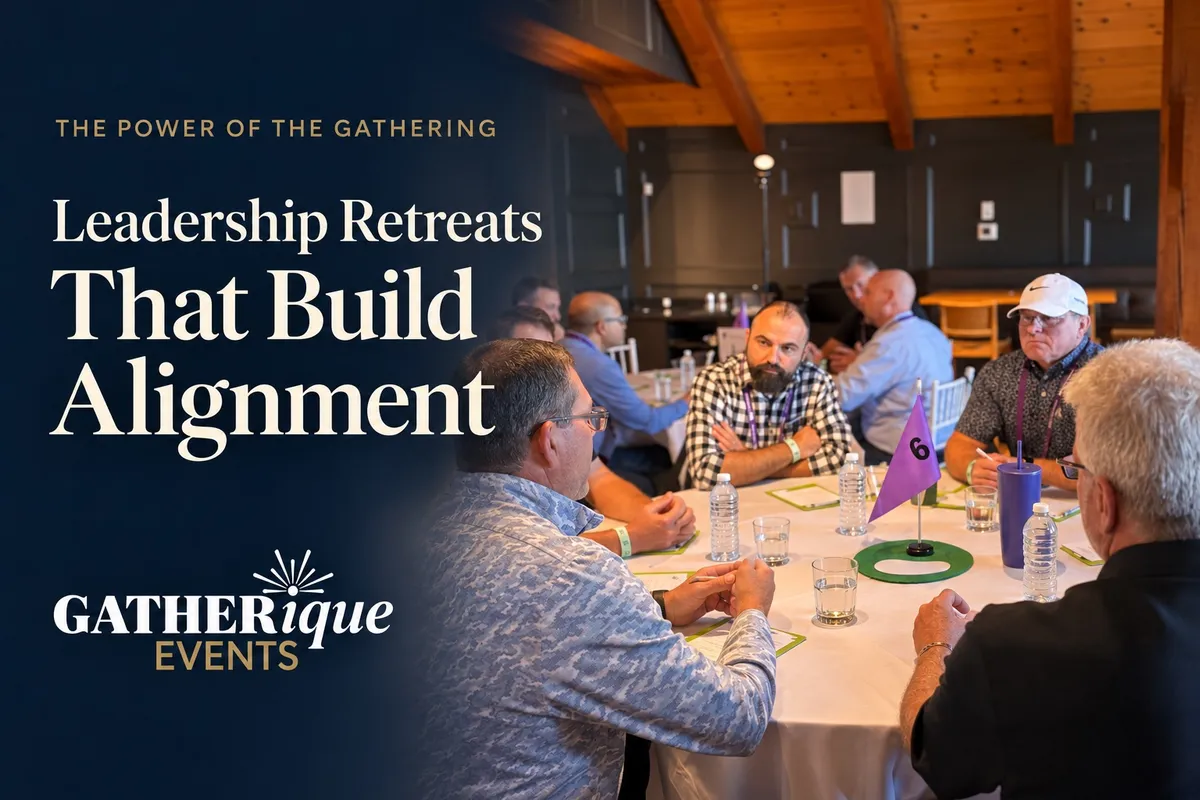
How to Design a Leadership Retreat in New England That Strengthens Alignment and Drives Strategic Growth
THE QUICK ANSWER
How do you design a leadership retreat that creates alignment?
Define the decisions leaders need to make, prepare them with shared information, and design sessions that turn different perspectives into clear choices. Choose a setting that supports confidential discussion and comfortable participation. Close with named owners, practical commitments, and a review schedule so the retreat’s work continues after the team returns.
Leadership alignment is more useful when it means something specific. Leaders may agree that growth matters while holding very different views about priorities, resources, and responsibilities. A retreat creates time to examine those differences and decide how the organization will move forward.
The venue and hospitality support that work, but they cannot replace it. The strongest retreat design connects the questions, participants, agenda, and follow-through before filling the schedule with activities.
At Gatherique Events in Manchester, New Hampshire, we approach leadership retreats as purposeful gatherings with clear planning requirements. Here is how to shape an offsite that respects executive time and creates a practical foundation for progress.
Identify the decisions that deserve protected time
Begin by listing the questions the leadership team has struggled to resolve in everyday meetings. These might involve priorities for a new phase of growth, responsibilities across departments, resource tradeoffs, or the way decisions move through the organization.
Separate topics that need discussion from topics that need a decision. “Review the strategy” is broad. “Agree on the three priorities that will guide the next planning cycle” gives the session a clearer destination. The retreat should have a manageable number of outcomes.
Clarify what is open and what is fixed
Tell participants which decisions they can influence and which constraints are already established. If the budget is fixed, make that clear. If a decision requires later board approval, explain what the retreat should produce for that review.
Ambiguity about authority can undermine a productive conversation. Leaders may leave believing they reached an agreement when another stakeholder considers it only a recommendation. Define the decision process before the retreat and record the status of each outcome afterward.
Our event strategy consulting helps turn a broad retreat idea into a brief the planning team can use. Clear decisions give the agenda its direction.
Invite the perspectives the work requires
The right group is not always the largest group or the most senior group. Consider who has the information, responsibility, and authority needed for the retreat’s purpose. A decision about cross-department work may require perspectives that are missing from a familiar executive circle.
Some contributors may be needed for a particular session rather than the entire retreat. Others may provide input in advance. Choose the arrangement deliberately and explain it so participation feels purposeful.
Prepare for differences in voice and influence
Seniority, personality, and familiarity can affect who speaks first and whose ideas receive attention. Build formats that allow people to think before responding. Individual reflection, paired discussion, and structured rounds can bring more perspectives into the conversation.
Agree on how the group will handle disagreement. The aim is to examine tradeoffs and assumptions, not to avoid difficult topics. A capable facilitator can help keep the discussion focused and ensure that a quick consensus does not hide unresolved concerns.
Use advance preparation to protect the best discussion time
Ask participants to review essential information before arriving. Keep the material focused on what they need to understand the decisions ahead. A concise brief with relevant data and clear questions is usually more useful than a large collection of documents without guidance.
Distinguish information sharing from collaborative work. Status updates that can be read in advance should not consume the most valuable session time. Use the retreat to compare interpretations, explore options, and make choices together.
Give preparation a clear purpose
Ask leaders to bring a small number of observations or recommendations tied to the agenda. For example, each department might identify one dependency that affects its priorities and one tradeoff it needs the team to address.
Confirm how sensitive information will be handled. Limit distribution to the people who need it and use the organization’s approved process for sharing materials. Participants should understand the expectations for confidentiality before arriving at the venue.
Build the agenda as a sequence of useful work
A strategic retreat agenda should help the team move from a shared understanding to a considered decision. Begin by clarifying the situation, then compare perspectives, examine options, and agree on the next step. The sequence matters because people need context before they can make a sound choice.
Include time to summarize what has been learned and check whether the group is ready to move forward. A discussion can feel energetic without producing a clear result. A short checkpoint helps distinguish progress from activity.
Design each session around an output
A session might produce a priority list, a decision record, a set of unresolved questions, or a draft responsibility map. Specify the intended output and the person who will capture it. This gives participants a shared understanding of what the session should achieve.
Build in realistic breaks and transitions. Difficult conversations need time to settle, and participants need opportunities to step away. Avoid placing every major decision into one long block without space to reflect.
Our guide to leadership retreats and stronger teams explores the relationship side of the experience. Trust and connection support strategic work when the agenda gives both appropriate attention.
Choose a New England setting that supports the agenda
The region offers city venues, coastal locations, countryside properties, and mountain settings. Start with the retreat requirements rather than the view. Consider travel, privacy, room layouts, overnight arrangements, technology, and the time available for the program.
Ask whether the group will have exclusive use of the meeting spaces and what else will be happening at the property. Confirm where confidential conversations can take place and how participants will move between sessions, meals, and accommodations.
Evaluate the practical experience
Check sound, seating, lighting, internet needs, and access. A discussion-focused retreat may need a different room arrangement from a presentation-heavy meeting. Confirm the equipment and staffing included in the proposal, and test the setup before relying on it.
If outdoor time is part of the plan, prepare an indoor alternative that serves the same purpose. Describe activities in advance and offer accessible choices. The retreat should not depend on everyone having the same comfort with physical activity or weather.
For one setting to explore, read our guide to The Preserve at Chocorua. Venue suitability still needs to be confirmed against your group, dates, and requirements.
Protect attention through thoughtful logistics
Leaders should receive clear information about travel, arrival, accommodation, the agenda, and preparation. Explain what is included and whom to contact with questions. Practical clarity helps participants arrive ready to focus.
Coordinate meals, room changes, and equipment around the working sessions. A late service or rushed transfer can interrupt a valuable discussion. Keep operational responsibilities separate from facilitation so the person leading the conversation is not also solving every logistical issue.
Plan for the human pace of the retreat
Give participants time to settle in and connect before demanding difficult decisions. Leave room for informal conversation without making the entire experience unstructured. People may develop a useful understanding over a meal that later improves the formal discussion.
Consider the demands of departure as well. Avoid scheduling the most important commitment-setting session while people are watching the clock for travel. A realistic closing window protects the handoff from conversation to action.
Turn agreement into an accountable next step
Before closing, review what the team decided and what remains open. Record the owner, next action, timing, and any dependencies. If a decision is provisional, say what information is needed to confirm it.
Ask leaders to explain the commitments in their own words. Differences in interpretation are easier to address while the group is still together. A shared document is useful only if people understand it consistently.
Schedule the first review before leaving
Set a review date that fits the work and identify who will maintain the action record. The follow-up should examine completed commitments, barriers, and decisions that need further attention. It should not simply repeat the retreat discussion.
A strategic event review can help connect the experience to future planning. Evaluate both the decisions produced and the process that helped or hindered the team.
PUT IT INTO PRACTICE
Imagine a growing organization whose departments have competing priorities. Before the retreat, leaders identify the dependencies that create friction. During the retreat, they compare options and agree on a shared sequence of work. They leave with named owners and a review date. The value comes from those clear commitments and the follow-through they enable.
YOUR RETREAT DESIGN CHECKLIST
Before leaders arrive
Define the decisions, outcomes, and authority in scope.
Invite the perspectives required for the work.
Provide focused preparation and confidentiality expectations.
Give each session a clear output and a responsible recorder.
Confirm the venue, technology, access, and travel details.
Protect breaks, reflection, and the closing commitment session.
Assign follow-up owners and schedule the first review.
Frequently asked questions
How long should a strategic leadership retreat be?
The length should reflect the decisions and preparation required. A focused issue may fit a single day, while several connected topics may need an overnight format. Avoid adding time without purpose or compressing difficult work into an unrealistic agenda.
Do we need an outside facilitator?
An outside facilitator can be useful when leaders need to participate fully, when the issues are complex, or when the group benefits from a neutral process. Clarify the facilitator’s role and subject-matter requirements separately from event logistics.
How do we measure alignment after the retreat?
Look for shared priorities, consistent understanding of decisions, clear responsibilities, and completed follow-up actions. Participant feedback adds context, but the strongest evidence is how the team applies its agreements in everyday work.
Design space for the decisions that matter
A purposeful retreat gives leaders a clear reason to step away and a practical plan for what follows. Gatherique Events can help shape the setting, structure, and coordination through leadership retreat planning in New England. Let’s discuss the work your team needs to do together.